

World Insights: Science should guide Fukushima wastewater release plan, Pacific leaders say
- Civil society groups in Japan and many international organizations have voiced objections to the Fukushima wastewater release plan, citing a lack of a practical demonstration and its potential threat to society and marine ecology.
- Analysts believe that Japan should not ignore the concerns and livelihoods of Pacific islanders.
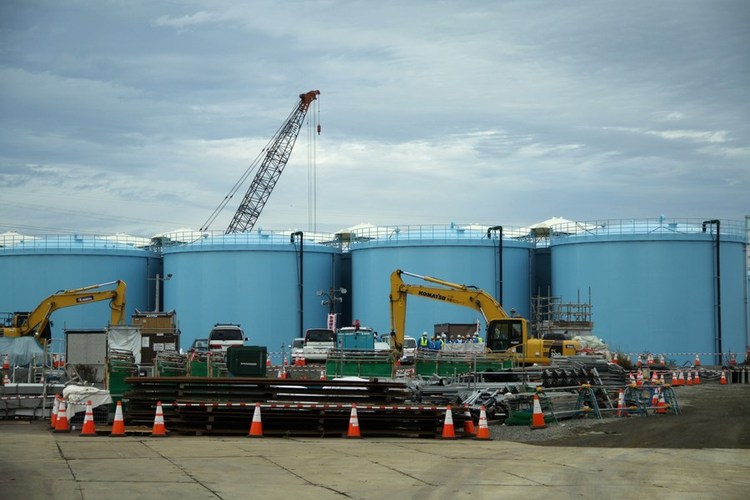
File photo taken on Oct. 12, 2017 shows huge tanks that store contaminated radioactive wastewater in Fukushima Daiichi nuclear plant, in Fukushima Prefecture, Japan. (Xinhua)
SUVA, Feb. 26 (Xinhua) -- Pacific leaders on Friday wrapped up the two-day Pacific Islands Forum (PIF) Special Leaders' Retreat in Fiji, where Japan's Fukushima wastewater release plan was in the limelight.
The PIF rotating chair underlined in a statement that science and data should guide political decisions on Japan's proposed discharge of treated radioactive wastewater from the wrecked Fukushima nuclear plant into the sea.
The outgoing chair and Fiji's Prime Minister Sitiveni Rabuka, together with other PIF leaders, believes the decision is not as simple as a domestic issue of Japan, but concerns the South Pacific island countries and beyond.
Given that related data and evidence provided by Japan are far from independent or verifiable, the PIF has called on the country repeatedly to delay the discharge plan.
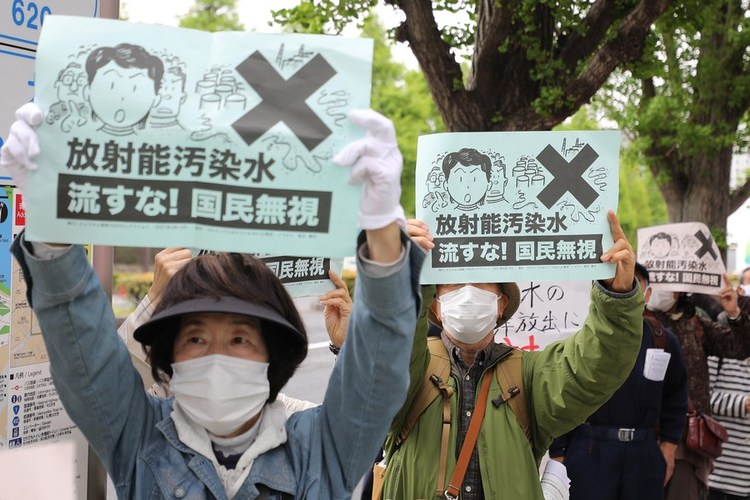
People rally to protest against the Japanese government's decision to discharge contaminated radioactive wastewater in Fukushima Prefecture into the sea, in Tokyo, capital of Japan, April 13, 2021. (Xinhua/Du Xiaoyi)
CRITICISM FROM INT'L COMMUNITY
Civil society groups in Japan and many international organizations have also voiced objections to the plan, citing a lack of a practical demonstration and its potential threat to society and marine ecology.
Over the past years, fishermen in neighboring countries have staged several rallies, calling for immediate stop to the "grave criminal act" of releasing radioactive water into the sea. Within Japan, local civic groups have organized protests outside the government house of Fukushima Prefecture.
Japan's unilateral push to discharge radioactive wastewater from its crippled Fukushima Daiichi nuclear power plant into the Pacific Ocean is irresponsible and harmful, South Korean green activists have said.
"The Pacific Ocean is not the sea of Japan, but the sea of everybody ... Pollutants will flow to neighboring countries in a situation that a lot of radioactive materials have already been released and contaminated (the marine ecosystem)," Ahn Jae-hun, energy and climate change director at the Korea Federation for Environment Movement, told Xinhua.
The Japanese government's decision to discharge the contaminated water into the sea when there are alternatives such as long-term storage violates the precautionary principle recognized by the international community, Greenpeace Seoul Office has said. Greenpeace is an independent global campaigning network for environment protection.
"We must prevent action that will lead or mislead us toward another major nuclear contamination disaster at the hands of others," said PIF Secretary General Henry Puna.
Take a look at how Japan proceeded with that.
The Japanese government decided in April 2021 to release more than one million tons of treated wastewater into the Pacific Ocean this spring.
Three months later, Japan greenlit the discharge plan while the International Atomic Energy Agency (IAEA)'s task force was still conducting the review mission.
Earlier this year, Japan unilaterally announced that it would start discharging the radioactive water in spring or summer, just before the agency's task force arrives in Japan for review.

A poster to boycott Japanese products is seen in a supermarket to protest against Japan's decision to dump radioactive wastewater from the crippled Fukushima Daiichi nuclear power plant into the Pacific Ocean, in Seoul, South Korea, April 14, 2021. (Photo by Xu Ruxi/Xinhua)
PACIFIC OPPOSITION
Pacific island countries unanimously oppose Japan's release plan for multiple reasons, citing ecological fragility, economic dependence on the fisheries industry, and the devastating effects of radioactive pollution caused by Western nuclear testing.
First, Pacific island countries are concerned that the released radioactive substances will spread with ocean currents and tides, risking contaminating fish. As more than half of the world's tuna comes from the Pacific Ocean, a potentially contaminated environment could hurt the fisheries that those countries rely on.
Second, the Pacific Ocean's delicate ecology may come under threat. If the wastewater release leads to an ecological disaster, the vulnerable island residents will leave their homes, causing an ecological and survival crisis that will deal a heavy blow to the entire Pacific region.
Last, Western countries have conducted a dazzling array of nuclear tests in the Pacific since the mid-20th century, resulting in shocking radioactive pollution and ecological disasters. These have left painful memories for islanders, who have been sensitive to the wastewater issue.
Analysts believe that Japan should not ignore the concerns and livelihoods of Pacific islanders. Neither should it dump the wastewater into the sea until disputes are settled over the legitimacy of the discharge plan, the reliability of radioactivity data, the effectiveness of purification equipment and the uncertainty of environmental impact, they added.
By Zeng Yan,Guo Yuqi,Zhang Yongxing,Wang Xinyi
上一篇:一汽大众(-,)