

Protectionism weakens US trade, experts say
Bleak forecast spelled out for return to brighter days of liberalization
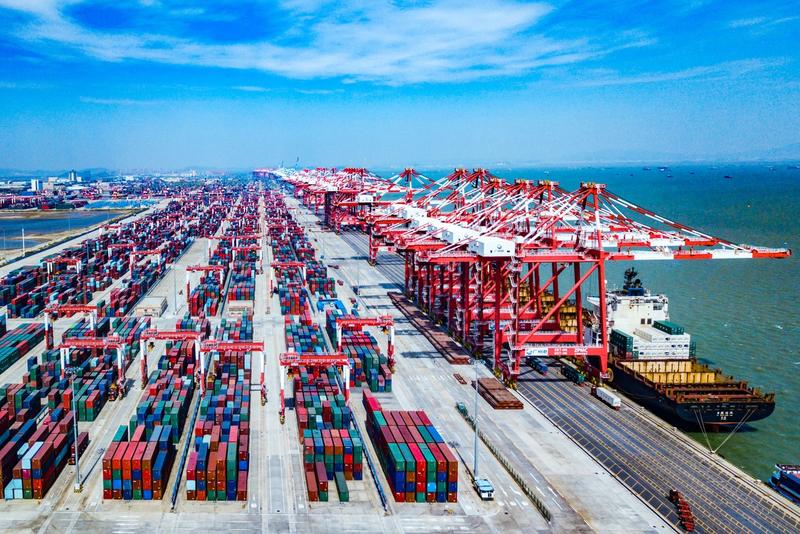
Photo shows a view of Nansha Port in Guangzhou, South China's Guangdong province. [Photo provided to chinadaily.com.cn]
Protectionist US trade policy in recent years has produced a bigger trade deficit and job losses, weakened the country's productivity and has diminished its diplomatic leadership, trade experts say.
"The protectionist policy, just during the (Donald) Trump administration, added over one hundred billion dollars to the US trade deficit," said Jack Midgley, principal of the global consultancy Midgley & Co and an adjunct associate professor in the Security Studies Program at Georgetown University, Washington.
"That's an immediate adverse impact. The job losses associated with that impact are in the hundreds of thousands of manufacturing jobs. So that's another negative impact on the US economy. So, it turns out employment, trade deficit, investment in manufacturing, infrastructure, and so forth, all extremely negative."
Gary Clyde Hufbauer, a senior fellow at the Peterson Institute for International Economics in Washington, said: "This trend has a decidedly negative impact on US productivity growth, now less than 0.5 percent annually. In the good old days it was nearly 2 percent annually. And US diplomatic leadership is badly weakened by the current trend."
In a policy brief titled "Have trade agreements been bad for America?" published last month, Hufbauer and Alan Wolff, another senior fellow at the Peterson Institute, said "expanded trade has greatly benefited the US economy" and that "protectionism is not the solution".
According to the brief, global trade and liberalization have helped lift hundreds of millions of people out of poverty worldwide and helped raise US GDP tenfold since World War II, but protectionism under president Donald Trump and his successor President Joe Biden undermined US authority globally.
"US-China trade has been very beneficial for the US over the past two decades," Hufbauer said. "I am very sorry this is not recognized by most US political leaders."
'Standstill' expected
Hufbauer said he expects "a standstill" in US-China trade relations over the next two years. "Not get much worse, but not get much better, either."
Hufbauer forecasted that Republicans in the US Congress would continue to call for new international trade agreements, and voiced skepticism that Biden or the US Trade Representative Katherine Tai would respond.
Instead, they will continue to negotiate the "Indo-Pacific" economic framework, the initiative on trade with Taiwan, and try to calm the electric vehicle dispute with the European Union, he added.
Hufbauer said he lacked optimism about any "big move" by the US in international trade. He forecast "a reversal by Biden" to seek US admission to the Comprehensive and Progressive Agreement for Trans-Pacific Partnership.
"I give this only a 25 percent chance. Another big move would be a free trade agreement with the UK.Again, only a 25 percent chance."
The US would continue to impose strict sanctions on Russia, Hufbauer said.
Midgley forecasted there would be no big US moves in advancing trade this year. Reasons include the macroeconomic environment and the domestic political regime, he said.
"I don't believe there will be any big moves in 2023. … Unfortunately, not much room in that environment for new free trade agreements. And similar factors will make it difficult to make progress on US-China trade in one or two years.
"And the prospect of a recession next year, plus the political environment, which is a Republican Congress. I think it's very unlikely that in the next 12 to 24 months … I doubt very much that there will be advances … in the area of free trade with China."
The most important reason for "no big move" with China or other trade partners is a US policy trend that is not conducive to trade, Midgley said.
"What is happening is that the United States is continuing to emphasize energy independence, massive increases in defense spending and defense investment, and a lot of that is crowding out attempts to liberalize trade policy. … don't see the political room or the economic incentive for the American government to do much in the area of free trade."
Political pressure from the US House of Representatives, now in Republican hands, will favor protectionism, Midgley said.
He expressed concern that the first thing the House Speaker Kevin McCarthy wants to do is "run off to Taiwan and put fingers into the eyes of the Chinese government", which would hurt US-China relations and reduce the chance of bilateral conversation on trade.
If you have any problems with this article, please contact us at app@chinadaily.com.cn and we'll immediately get back to you.